
Math Worksheets
A year’s worth of printable math practice in one pack. Worksheets are organised by grade band and skill — from number sense and fact fluency in the early grades to multi-digit multiplication, long division, fractions and decimals later on — with mixed review sheets that keep earlier skills fresh. Every worksheet comes with an answer key.
- Instant download
- Editable Word & Excel
- Print-ready PDF
- 7-day refund
11 files · PDF, DOCX, XLSX
Math Worksheets Pack (Grades 1–5)
Printable math worksheets with answer keys for grades 1–5: place value, addition, subtraction, multiplication, division, rounding, fractions, decimals, money, order of operations, word problems and mixed review, plus an Excel progress tracker.
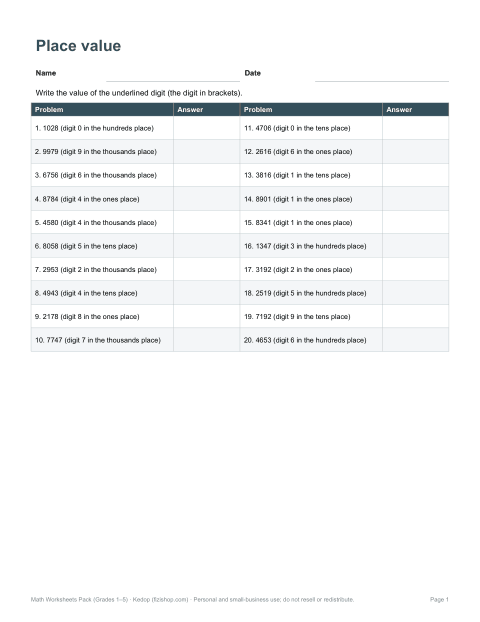
- Place value (PDF, DOCX)
- Rounding (PDF, DOCX)
- Multiplication facts (PDF, DOCX)
- + 8 more
$7.00 USD, one-time 11 files · about $0.64 each
- Instant download
- 7-day refund
- Secure checkout by Stripe
7-day money-back guarantee. Full refund within 7 days of purchase, even after you download.
Free sample: Place Value (PDF, 58 KB)
Math Worksheets Pack (Grades 1–5)
Printable math worksheets with answer keys for grades 1–5: place value, addition, subtraction, multiplication, division, rounding, fractions, decimals, money, order of operations, word problems and mixed review, plus an Excel progress tracker.
- Place value (PDF, DOCX)
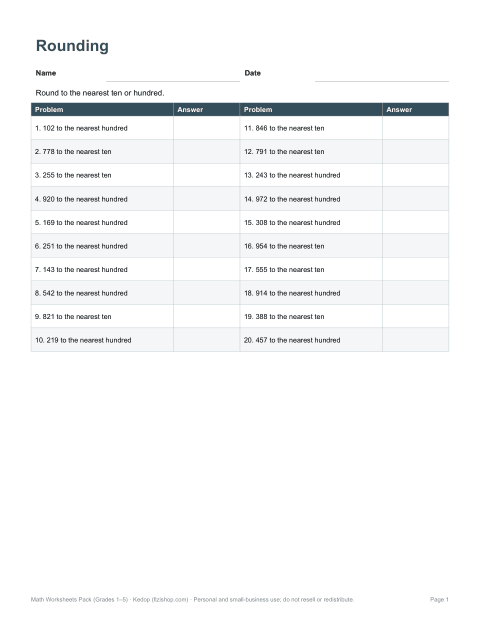
- Rounding (PDF, DOCX)
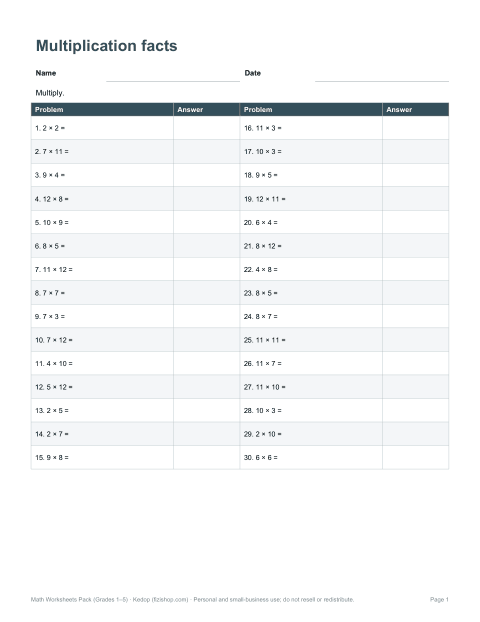
- Multiplication facts (PDF, DOCX)
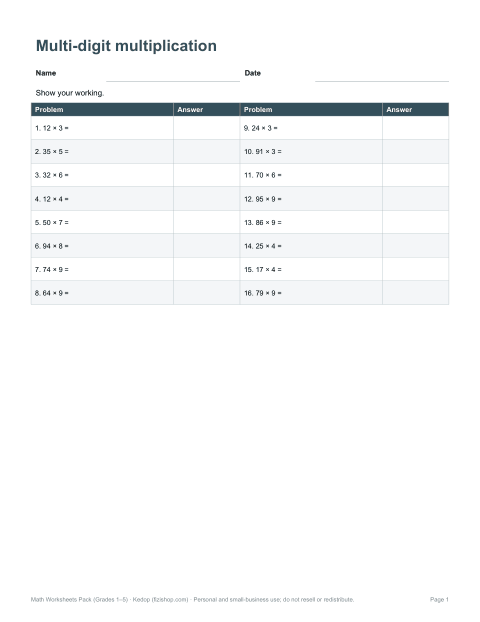
- Multi-digit × (PDF, DOCX)
- Division (PDF, DOCX)
- Fractions (PDF, DOCX)
- Decimals (PDF, DOCX)
- Order of operations (PDF, DOCX)
- Money (PDF, DOCX)
- Mixed review (PDF, DOCX)
- Progress tracker (XLSX)
Formats: PDF, DOCX, XLSX. Instant download after payment (link valid 72 hours, up to 5 downloads). AI-assisted: the templates were drafted with AI help and reviewed and laid out before publishing.
$7.00 USD, one-time 11 files · about $0.64 each
- Instant download
- 7-day refund
- Secure checkout by Stripe
7-day money-back guarantee. Full refund within 7 days of purchase, even after you download.
Free sample: Place Value (PDF, 58 KB)
Full refund within 7 days — see the refund policy and license.
Free printables
Single sheets you can print right now, no sign-up. The full pack adds every sheet in one download plus the editable files.
 Printable Place Value Worksheet2 pages · free PDF
 Printable Rounding Worksheet2 pages · free PDF
 Printable Multiplication Facts Worksheet2 pages · free PDF
 Multi-Digit Multiplication Worksheet2 pages · free PDF
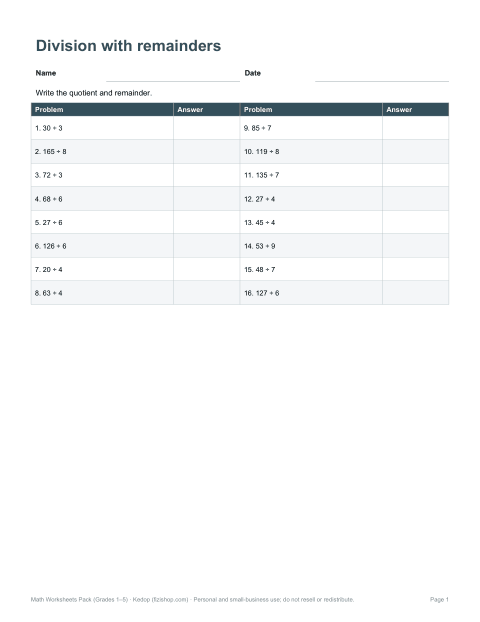
 Printable Division With Remainders2 pages · free PDF
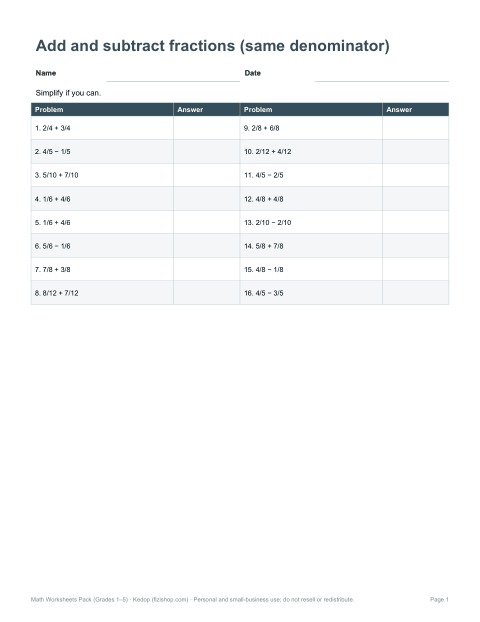
 Printable Fractions Practice Sheet2 pages · free PDF
 Printable Decimals Adding and Subtracting Worksheet2 pages · free PDF
 Printable Order of Operations Worksheet2 pages · free PDF
Skills covered by grade band
| Grade band | Main skills |
|---|---|
| Grades 1–2 | Counting and place value to 1,000, addition and subtraction facts, two-digit addition and subtraction, telling time, money |
| Grades 3–4 | Multiplication and division facts, multi-digit addition and subtraction, rounding, fractions on a number line, area and perimeter |
| Grade 5 | Multi-digit multiplication, long division, decimals, adding and subtracting fractions, volume, order of operations |
| All grades | Mixed review and word problems |
Standards and grade expectations differ between countries and school systems. Use the skill names rather than grade labels if your child’s curriculum moves at a different pace.
How to use mixed review
Research on learning suggests that practice spread over time, with different types of problems mixed together, leads to better long-term retention than doing many problems of one type in a row. The mixed review sheets include a few problems from each recent topic. They are ideal as a weekly warm-up or homework once children have learned each skill separately.
Getting the most from worksheets
- Keep sessions short — 10–20 minutes depending on age.
- Ask children to explain one answer aloud: explaining shows real understanding.
- Use manipulatives (blocks, coins, fraction strips) alongside the sheets.
- Mark together and look for patterns in mistakes.
- Revisit a topic a few weeks later with a mixed review.
- Celebrate effort and progress, not just scores.
Sample problems
| Skill | Example | Answer |
|---|---|---|
| Place value | What is the value of 7 in 4,732? | 700 |
| Rounding | Round 368 to the nearest ten | 370 |
| Multiplication | 34 × 6 | 204 |
| Division | 156 ÷ 12 | 13 |
| Fractions | 2/5 + 1/5 | 3/5 |
| Decimals | 4.6 + 2.75 | 7.35 |
| Order of operations | 3 + 4 × 5 | 23 |
| Money | $5.00 − $3.45 | $1.55 |
Word problems
Word problems connect math to real situations and build reading and reasoning skills. Encourage a simple routine: read the problem twice, underline what is being asked, draw a picture or bar model, choose the operation, solve and check whether the answer makes sense. The word problem sheets mix operations so children must decide what to do rather than following a pattern.
Fact fluency
Quick recall of addition, subtraction, multiplication and division facts frees working memory for harder problems. The fact fluency sheets are designed for a few minutes of daily practice; the tracker records accuracy and time so progress is visible. Aim for accuracy first and speed later.
Using manipulatives with worksheets
Concrete objects make abstract ideas visible. Base-ten blocks show place value and regrouping, coins make money problems real, fraction strips or paper folding show equivalent fractions, and arrays of counters show multiplication. When a child is stuck on a worksheet problem, model it with objects first, then draw it, then return to the numbers — the “concrete, pictorial, abstract” sequence used in many classrooms.
Worked example: a weekly plan for grade 3
Monday: multiplication facts for 6 and 7. Tuesday: rounding to the nearest ten and hundred. Wednesday: fractions on a number line. Thursday: two-step word problems. Friday: mixed review sheet and fact fluency check. Each session takes about 15 minutes, and the answer keys make it easy for a parent or the child to check the work.
Formats
Print-ready PDF worksheets with answer keys (US Letter; A4 with “Fit to page”), a Word word-problem template and an Excel fluency and progress tracker.
Frequently asked questions
What grades are the math worksheets for?
Grades 1–5, organised by skill.
Do the worksheets include answer keys?
Yes, every worksheet has an answer key.
Are the worksheets aligned to a curriculum?
They cover common elementary skills; check them against your school’s standards and pace.
How often should children practise?
Short daily sessions of 10–20 minutes work well.
Was AI used to create the worksheets?
Problems were generated by script and text drafted with AI assistance, then reviewed before publishing.